Consider replacing your eavestroughs when they sag or pull away from the roofline, leak at the seams again after repairs, show rust, cracks, or holes, overflow during normal rainfall, or let water collect around your foundation. An older system that needs repairs every season is usually a better candidate for replacement than another round of patching. A single, isolated problem on a newer system can often be repaired.
Eavestroughs — often called gutters — are easy to forget about until something goes wrong. Their job is simple: collect the water running off your roof and carry it safely away from your home. When they stop doing that job well, water ends up where it shouldn’t be: behind your fascia, down your siding, and around your foundation.
In Ontario, eavestroughs work hard. Heavy spring rain, fall leaves, snow loads, ice, and repeated freeze-thaw cycles all put stress on the system year after year. Catching the warning signs early can help you deal with a small problem before it turns into a bigger repair.
In this article
Why Your Eavestroughs Matter
A properly working eavestrough system helps protect:
- Your foundation and basement — by directing roof water away from the walls of the house.
- Fascia and soffit — the roof edge your eavestroughs are mounted to.
- Siding and exterior walls — from overflow, streaking, and staining.
- Landscaping, walkways, and driveways — from erosion and, in winter, icy patches where water drips and refreezes.
That’s why a failing eavestrough isn’t just a cosmetic problem. Water that isn’t managed properly can affect several parts of your home at once.
9 Signs It’s Time to Replace Your Eavestroughs
Sagging or Pulling Away From the Roofline
Eavestroughs should sit tight and straight along the fascia. If sections are drooping, bowing between hangers, or separating from the house, the hangers may have loosened or failed — or the fascia board behind them may be deteriorating.
Snow and ice add a lot of weight over the winter, so sagging often gets worse after a hard season. A sagging trough also holds water instead of draining it, which adds even more weight.
Leaking Seams and Corners That Keep Coming Back
Traditional sectional eavestroughs are joined together in multiple places, and every joint relies on sealant to stay watertight. Over time, sealant can dry out, crack, and separate — especially after years of temperature swings.
Resealing a joint is a reasonable fix once or twice. But if you’re chasing new leaks every season, the system may be telling you it’s time for a replacement. Seamless eavestroughs are formed to length on site, so they have far fewer joints where leaks can start.
Cracks, Holes, Rust, or Corrosion
Small holes can sometimes be patched, but cracks, rust, and corrosion tend to spread. Older steel eavestroughs are especially prone to rust, while aluminum can still crack, dent, or develop holes from age, impact, or ice.
If you notice orange or dark streaks, flaking metal, or daylight through the bottom of the trough, replacement is usually more practical than patching section after section.
Overflowing During Normal Rainfall
Some overflow during an extreme downpour can happen. But if water regularly spills over the edge during ordinary rain, something isn’t working. Common causes include:
- Clogs from leaves, maple keys, and roof debris
- A slope that doesn’t carry water toward the downspouts
- Too few downspouts, or downspouts that are too small
- Eavestroughs that are undersized for the roof area they serve
Cleaning may solve a clog. But if the system is undersized or poorly laid out, a properly sized replacement — for example, moving from 5″ to 6″ eavestroughs or adding downspouts — may be the better long-term fix.
Standing Water and Poor Slope
Eavestroughs need a slight slope toward each downspout so water keeps moving. A common guideline is roughly ¼″ of drop for every 10 feet, although the right pitch depends on the length of the run and the layout of the home.
After a rainfall, look for water sitting in the trough. Standing water adds weight, encourages debris buildup, and can freeze solid in winter. If the hangers have shifted or the fascia has moved, simply re-pitching the eavestrough may not be enough on its own.
Water Stains, Peeling Paint, or Rotting Fascia
Look at the fascia, soffit, and siding directly below your eavestroughs. Water stains, peeling paint, streaks down the siding, or soft and rotting wood are all signs that water has been escaping behind or over the trough.
Damaged fascia also gives the eavestrough a weaker surface to attach to. In many cases, the right fix is to address the fascia and eavestroughs together — and wrapping the fascia in custom aluminum capping can help protect it going forward.
Water Pooling Near Your Foundation or a Damp Basement
One of the most important jobs of an eavestrough system is moving water away from your foundation. If you see puddles along the base of your walls, soil washing away next to the house, or new dampness, musty smells, or water stains in the basement, your eavestroughs and downspouts may not be doing their job.
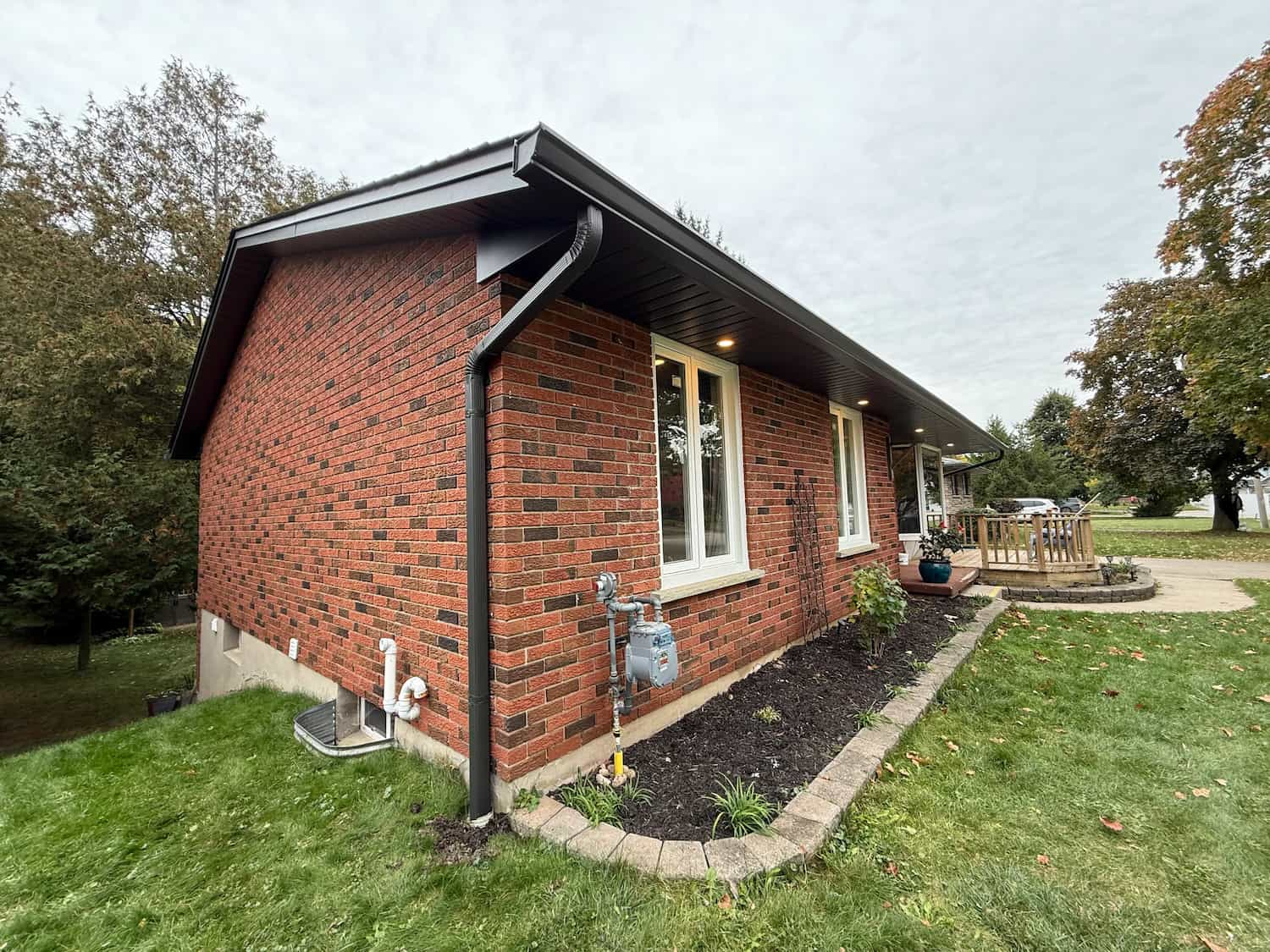
Sometimes the issue is the downspouts themselves. They may discharge right beside the foundation, be disconnected, or be positioned where the ground slopes back toward the house. Better downspout placement and extensions that carry water away from the walls can make a real difference.
Good to know: Basement moisture can have more than one cause, including grading and foundation issues. If water problems continue after your eavestroughs and downspouts are working properly, have the rest of the drainage around your home assessed too.
Eroded Garden Beds or Icy Patches Below the Roofline
Water pouring over the edge of an eavestrough lands in the same spot every time it rains. Over time, that can wash out mulch and soil, flatten plants, and leave a trench along the drip line.
In winter, the same overflow can drip onto walkways, steps, and driveways and refreeze into slippery ice — a safety concern as much as a maintenance one.
An Older System That Needs Constant Repairs
Every eavestrough system eventually reaches the end of its service life. Aluminum eavestroughs commonly last 20 years or more, but the actual lifespan depends on the material, the quality of the original installation, the condition of the fascia, maintenance, and exposure to trees, snow, and ice.
If your eavestroughs are original to an older home and you find yourself repairing something every year, replacing the system is often more cost-effective than continuing to patch it.
Should You Repair or Replace Your Eavestroughs?
Not every eavestrough problem calls for a full replacement. As a general rule:
A repair often makes sense when…
- The system is relatively new and in good overall condition
- The problem is isolated — one leaking corner, a loose hanger, or a single damaged section
- The fascia behind the eavestrough is solid
- The eavestroughs are properly sized and sloped
Replacement often makes sense when…
- Problems are showing up in several places at once
- Leaks keep returning after repairs
- There’s widespread rust, cracking, or sagging
- The fascia needs repair or replacement
- The system is undersized or poorly laid out for your roof
- The eavestroughs are near the end of their service life
The best way to know for sure is to have the system looked at. During a free estimate, we’ll inspect your eavestroughs, downspouts, and fascia and explain whether a repair or a replacement makes more sense for your home.
How Ontario Weather Affects Your Eavestroughs
Southern Ontario’s climate is tough on eavestroughs:
- Freeze-thaw cycles. Water left in the trough or in its joints can freeze and expand, stressing seams, hangers, and fasteners.
- Snow and ice loads. Heavy snow and ice add weight along the roof edge, which can loosen hangers and bend sections.
- Ice dams. Ice dams form when snow melts higher on the roof and refreezes near the colder edge. They’re usually tied to attic insulation and ventilation, but the ice that builds up can damage eavestroughs and push water back under the roof edge. Proper soffit ventilation is part of the solution.
- Fall leaves and spring debris. Mature trees can fill eavestroughs quickly, leading to clogs and overflow.
Because of this, it’s a good idea to check your eavestroughs after the snow melts in spring and again after the leaves have fallen in autumn.
What to Consider When Replacing Your Eavestroughs
If replacement is the right call, a few decisions will shape how well the new system performs.
Seamless vs. sectional eavestroughs
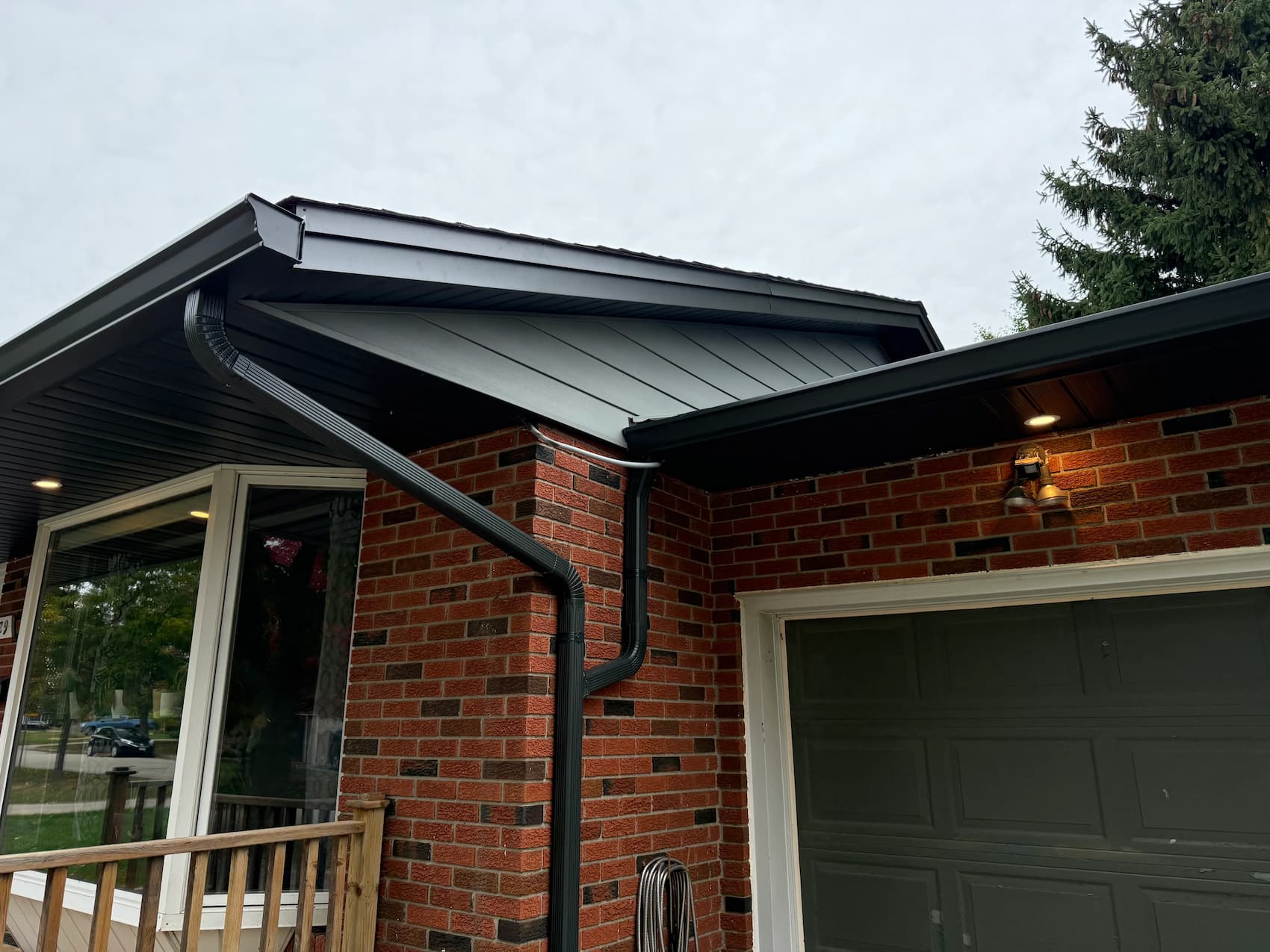
Seamless aluminum eavestroughs are formed on site to fit each run of your home, with joints only where they’re needed — at corners and downspout outlets. Fewer joints means fewer places for leaks to develop, and a cleaner look along the roofline.
5″ or 6″ eavestroughs
A 5″ eavestrough works well for many homes. A 6″ system carries more water, which can help on larger roof areas, steeper roofs, or homes surrounded by mature trees. The right size depends on your roof.
Downspout size and placement
Downspouts are just as important as the troughs. The number, size, and placement of downspouts — and where they discharge — determine how effectively water is moved away from the house. Rain barrel diverters can also be added if you’d like to collect rainwater for the garden.
Leaf guards
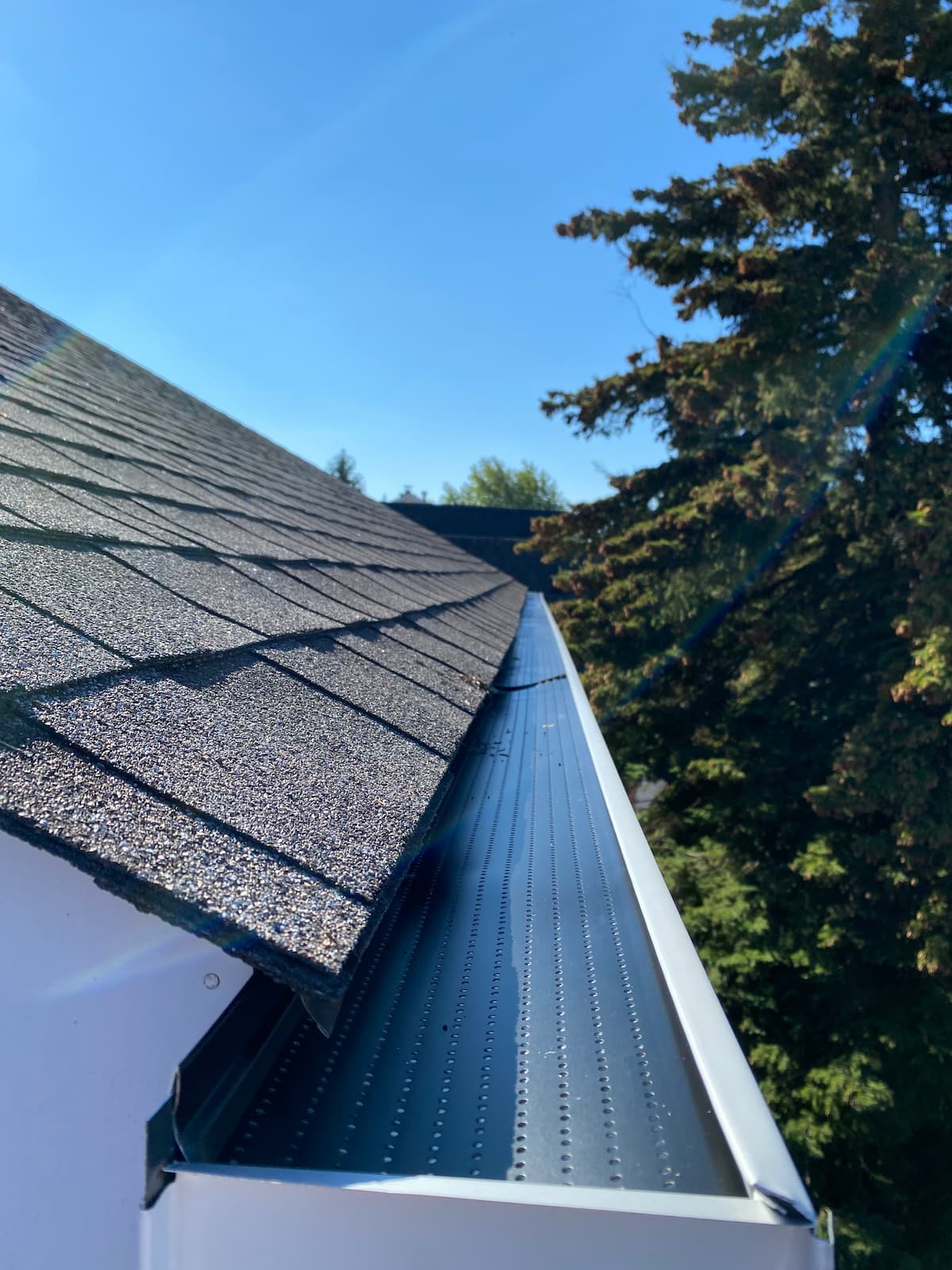
If you have trees nearby, a leaf guard system can reduce clogs and how often your eavestroughs need cleaning. We install Alu-Rex T-Rex® and DoublePro® leaf guard systems. Leaf guards reduce maintenance, but they don’t eliminate it entirely.
The condition of your fascia
New eavestroughs need solid fascia to attach to. If the fascia is damaged, it should be repaired before the new system goes up — and an eavestrough replacement is a convenient time to update your soffit and fascia as well.
How to Help Your Eavestroughs Last Longer
A little regular attention goes a long way, whether your eavestroughs are brand new or a few years old:
- Clean them at least twice a year — typically in late spring and again in late fall after the leaves drop
- Check for loose sections, sagging, or debris after major storms
- Make sure downspouts are clear and discharge water well away from the foundation
- Trim back overhanging branches where possible
- Watch for drips, overflow, and stains during the next heavy rain
- Consider leaf guards if cleaning has become a frequent chore
Working from a ladder near the roof edge can be dangerous. If you’re not comfortable doing it safely, have a professional handle the inspection and cleaning.
Frequently Asked Questions
How long do eavestroughs last in Ontario?
Aluminum eavestroughs commonly last 20 years or more. The actual lifespan depends on the material, the quality of the installation, how well the system is maintained, the condition of the fascia, and how much exposure it gets to trees, snow, and ice.
Older steel eavestroughs can be more prone to rust, and sectional systems may develop leaks at their joints sooner as the sealant ages.
Can eavestroughs be repaired instead of replaced?
Yes, in many cases. Isolated issues such as a leaking corner, a loose hanger, or a single damaged section can often be repaired.
If problems are widespread, keep coming back after repairs, or the fascia behind the eavestroughs is damaged, replacement is usually the better long-term option.
Are seamless eavestroughs worth it?
For many homes, yes. Seamless eavestroughs are formed on site to fit each run of the house, so they have far fewer joints than sectional systems. Fewer joints means fewer places for leaks to develop, plus a cleaner appearance.
Should I choose 5-inch or 6-inch eavestroughs?
It depends on your roof size, roof pitch, and how much water needs to be managed. A 5″ eavestrough works well for many homes, while a 6″ system carries more water and can be a better fit for larger or steeper roofs and homes surrounded by mature trees. We’ll recommend a size during your estimate.
Should I replace my eavestroughs when I replace my roof?
It’s often a good time to consider it, especially if your eavestroughs are older or the fascia needs work. Coordinating the projects makes it easier to address the roof edge, fascia, and eavestroughs together.
What time of year is best to replace eavestroughs?
Eavestroughs are commonly replaced from spring through fall, when the weather is more predictable. Replacing a failing system before the fall leaves and winter snow arrive helps make sure your home is protected during the hardest part of the year.